Experiential entertainment marketing is physical campaign creative built around the title — in-theater activations, immersive environments, specialty builds, photo moments, environmental takeovers, and social-first fan installations that connect back to the larger campaign system.
What fans want is to go deeper into the world of the title. A doorway. A prop. A photo. Something that gets them closer than a trailer, a poster, or a social post can on its own.
At The Refinery, experiential creative is built for that appetite — and connected to the larger campaign system across key art, OOH, platform creative, social, and finishing.
What makes experiential work actually work?
Not size. Specificity.
Does the experience feel like the title? Does it reward the fan? Does it photograph well without becoming hollow? Does it give the audience something to participate in, not just look at? Does it connect back to the campaign idea?
That is the difference between an activation and a memory. One checks a box. The other gives fans a reason to stop, step closer, and say: I need a picture of this.
A campaign does not need to be enormous to feel experiential. It needs to create a behavior. Stand here. Hold this. Find that. Take the photo. Step inside. Bring someone over. Post it. Tell the group chat.
The physical moment can be small. The fandom around it usually is not.
How does experiential connect to the larger campaign?
A physical environment should feel like the campaign, not like it wandered in from somewhere else. The strongest experiential ideas extend the campaign’s visual language into space — color, material, typography, scale, texture, lighting, story cues, and the emotional promise of the title.
The Refinery’s background in key art, OOH, social, platform creative, and finishing shapes that thinking. We know how a campaign image becomes a system. Experiential asks a related question: what happens when that system becomes physical?
The answer should not be more signage.
What does modern experiential have to do for two audiences?
The person who is physically there, and the person who sees it later on a phone.
A fan photo, talent post, recap video, shaky vertical clip, or social carousel can keep the experience moving long after the first audience has left. That means the experience has to be built with replay in mind. Can someone understand it in one photo? Is there a natural frame? Is the title visible? Does the detail reward a closer look? Does it give people something to do with their hands, their camera, their friends, their fandom?
Experiential is physical. Its afterlife is usually digital.
What The Refinery creates for experiential campaigns
| Format | Primary job |
|---|---|
| In-theater activations | Standees, photo moments, decals, wraps, door clings, lobby displays |
| Immersive environments | Multi-room builds, escape rooms, environmental art for walls and floors |
| Specialty OOH builds | Dimensional placements that invite physical interaction and social capture |
| Environmental takeovers | Block takeovers, themed spaces, franchise installations |
| Story corners and fan installations | D23, conventions, fan-facing campaign touchpoints |
| Social-first photo moments | Frames, props, and builds designed for in-person participation and digital sharing |
Proof
The Refinery has created in-theater activations and physical campaign extensions across studios, streamers, and franchise campaigns.
For Snow White, the work included in-theater standees, photo moments, and mirror decals — and a fully realized four-room escape room experience where guests entered through an enchanted storybook, with The Refinery delivering all art for walls, floors, and environmental surfaces throughout. Story corner activations for the title also appeared at D23.
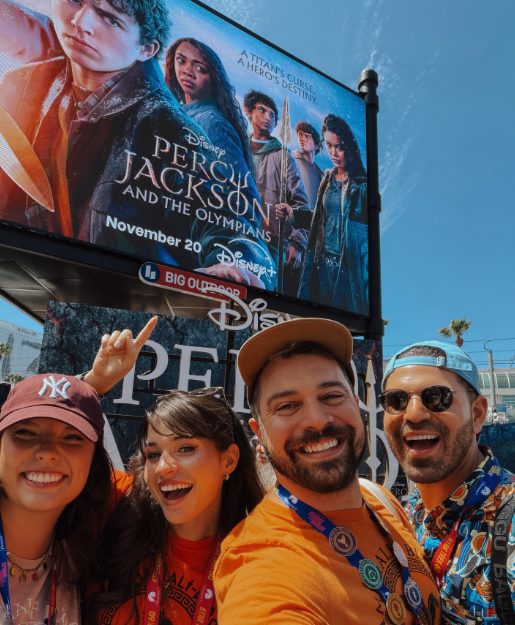
For Percy Jackson and the Olympians Season 3 at San Diego Comic-Con, The Refinery created a choose-your-own-adventure fan activation built around a towering Poseidon’s trident. Fans entered through the trident and chose one of three character paths — Percy, Annabeth, or Thalia — each leading into a distinct environment reflecting that character’s traits and story. Prophecy-led clues, hidden Easter eggs from the upcoming season, and exclusive Camp Half-Blood pins were embedded throughout. It is the kind of activation that gives a franchise audience exactly what they came for: a reason to feel like they are already inside the world.
For Zootopia 2, The Refinery created in-theater mirror decals, escalator wraps, and theater-entrance door clings. For Toy Story 5, floor clings and a lilypad archway installation brought the film’s world into physical space. For Kingsman, in-theater standees and activations extended the campaign into theater environments.
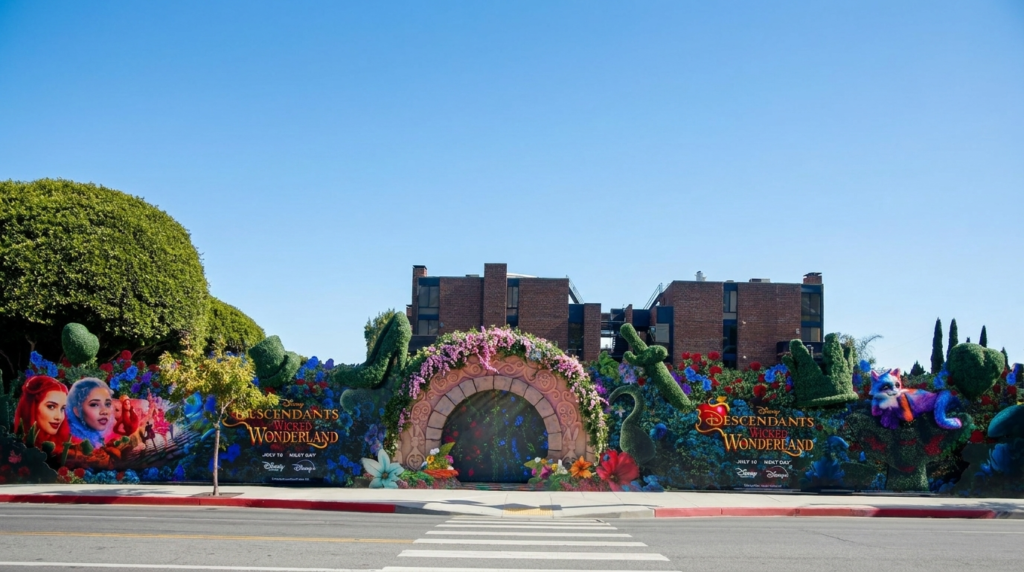
The line between OOH and experiential is also getting thinner. A specialty outdoor build, dimensional takeover, or immersive placement can function as both media and experience — seen by passersby, captured by fans, and remembered as a real-world encounter with the title. The Refinery’s OOH work for Paradise Season 2 and Descendants: Wicked Wonderland sits in that space. (For more on how The Refinery approaches specialty and immersive OOH, see our post on out-of-home creative.)
For a full overview of what The Refinery creates for entertainment campaigns, start here.