Out-of-home used to be more obedient. A campaign had key art, the key art became a billboard, maybe a bus shelter, maybe a few transit placements. Digital boards, when they appeared, were often just the same art with a little motion added — a JPEG learning to blink.
Now it’s a fully custom creative execution, using motion, pacing, reveal, and environmental context to make a title feel bigger than the placement. At The Refinery, out-of-home isn’t a media placement that gets creative attached at the end. It’s treated as a campaign moment.
We partner with studios, streamers, networks, and entertainment marketers on static, specialty, digital, 3D, anamorphic, and immersive OOH for film, television, streaming, entertainment brands, and awards campaigns, connected to the larger system: key art, platform creative, social strategy, PR, FYC, and finishing.
How has digital OOH changed?
“When I started, digital OOH was not really a thing in the way it is now,” says Molly Kloss, The Refinery’s executive creative director. “A lot of the time, it was basically key art resized for a screen, maybe with a little motion added.”
Now it’s a custom-built creative moment, using motion, pacing, reveal, and environmental context to make a title feel bigger than the placement. The Refinery’s recent 3D and digital work includes IT: Welcome to Derry, Ted 2, America’s Got Talent, The Copenhagen Test, The Traitors, and The Day of the Jackal. The strongest boards weren’t larger versions of existing art — they were built as moments with their own behavior and timing.
What makes OOH worth stopping for?
Scale is useful but it isn’t a concept. The better question isn’t how large a placement is — it’s what the placement is doing that only it can do. For Final Destination: Bloodlines, buses were designed to look like semi-trucks carrying logs, a billboard was staged to look like an installer had fallen, and a shelter appeared shattered. Those aren’t placements — they’re disruptions in the day that understand the title and the audience.
Does OOH need to work for social too?
Yes. The real audience now includes the person walking past, the person filming from across the street, and the person who never sees the physical placement but experiences it through a vertical video. That changes the creative questions: where’s the reveal, how long is the loop, does it read in a shaky phone video, is the title visible at the right moment. The best OOH isn’t just seen — it circulates.
Does location change the creative approach?
Yes, meaningfully. Times Square is pedestrian, dense, vertical, and built for social capture. Los Angeles is automotive, horizontal, speed-based, built for a quick read from a car. A Times Square 3D board can use spectacle and duration. A Sunset placement needs instant clarity and a graphic read.
International markets push that logic further. Tokyo’s major station environments are high-density, multi-surface, and built around commuter flow, which changes how motion, timing, and hierarchy need to work. A campaign that reads well on Sunset may need to be completely rethought for a transit hub or open-air crossing in Shibuya.
What The Refinery creates for OOH campaigns
| Format | Job | Recent example |
|---|---|---|
| Static OOH | Fast recognition: billboards, transit, wild postings | SNL 50 Sunset barricade |
| Specialty OOH | Dimensional, custom-fabricated builds | Final Destination: Bloodlines bus wraps, shattered glass-skull shelter |
| Digital OOH | Motion, timing, screen-native reveals | Survivor 50, Godzilla boards (FOX, NYC) |
| 3D and anamorphic OOH | Forced-perspective, social-first spectacle | IT: Welcome to Derry, The Day of the Jackal |
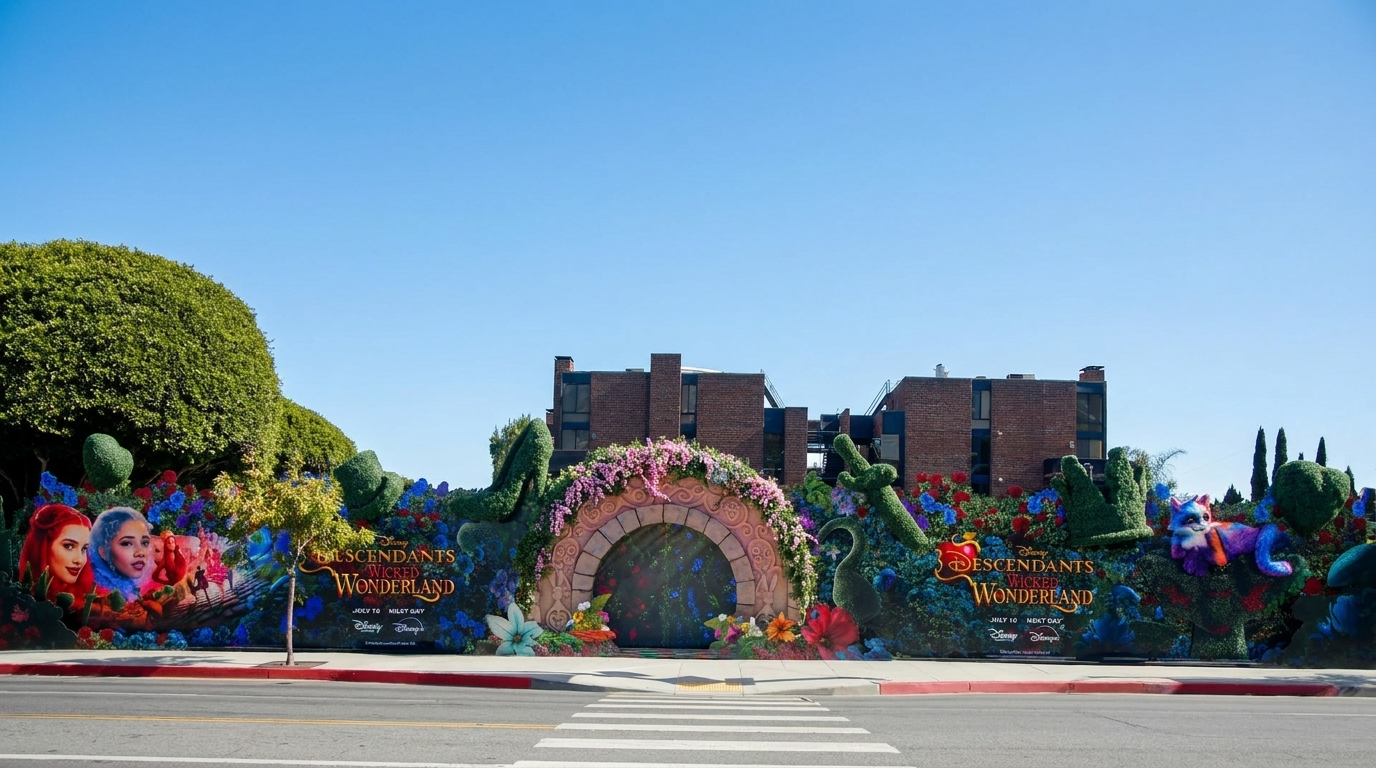
| Environmental/immersive | Block takeovers, fan-facing installations | Descendants: Wicked Wonderland barricade, Percy Jackson and the Olympians S3 Comic-Con fan experience |
| Social-first OOH | Built to be filmed, posted, replayed | Paradise Season 2 bunker |
Proof
The Refinery builds OOH inside the larger campaign system — key art, platform creative, social, PR, FYC, and physical placement moving together. Four things guide the work: specific to the title, specific to the place, legible in the real world (distance, glare, traffic, crowds), and worth remembering.
For Final Destination: Bloodlines, The Refinery created specialty OOH that turned everyday street objects into campaign moments — buses redesigned as log-carrying semi-trucks, a billboard staged to look like an installer had fallen, a bus shelter appearing shattered. For Alice in Borderland on Netflix, The Refinery created a subway takeover in Tokyo and a digital OOH campaign at Shibuya Crossing, two of the highest-density media environments in the world.
For a full overview of what The Refinery creates for entertainment campaigns, start here.